Abstract
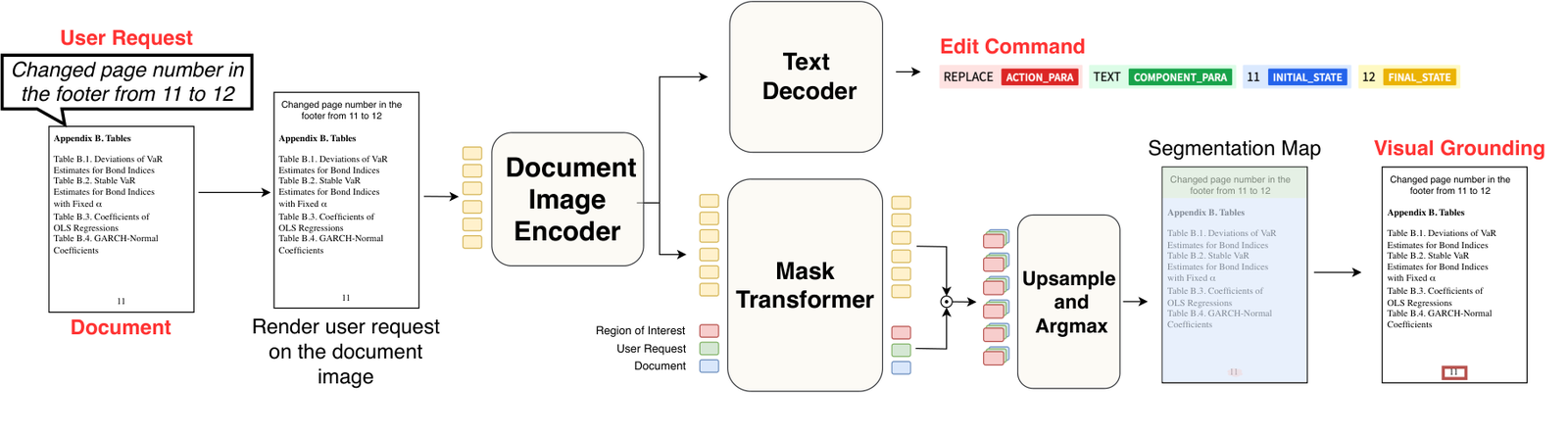
This short paper introduces Doc2Command, a multi-task multimodal model for language-guided document editing. Given a document image and a natural-language edit request, Doc2Command jointly localizes the region of interest that the request refers to and translates the request into a structured edit command with an action, a component, and its initial and final states. The request is rendered directly onto the document image so that a single image encoder processes language and layout together; a text decoder generates the command and a mask transformer produces the grounding as a segmentation map. Doc2Command later became the grounding and command generation component of DocEdit-v2 (EMNLP 2024), and this summary is based on the description of the model in that paper.
The problem
Edit requests in the DocEdit dataset are open-vocabulary and often ambiguous: “change the page number in the footer from 11 to 12” has to be resolved to a specific component on a dense page and to a precise action on that component. Prior work treated grounding and command generation as separate problems, and models that regress bounding box coordinates directly perform poorly on document images, where the target may be a single line of text among hundreds.
Approach
- One visual input. Rather than encoding the request as text, we render it as a text box on top of the document image and feed the combined image to a pre-trained Vision Transformer encoder borrowed from Pix2Struct. The image is not scaled to a fixed resolution; the scaling factor is chosen to fit as many fixed-size patches as the encoder’s sequence length allows, which keeps the model robust to extreme document aspect ratios.
- Edit command generation. A pre-trained Pix2Struct text decoder autoregressively generates the command
ACTION(<Component>, <Initial State>, <Final State>)from the patch embeddings. - Multimodal grounding as segmentation. A DETR-style mask transformer with three learnable class embeddings (region of interest, rendered request, remaining document) produces class masks by a scalar product with the patch embeddings. The masks are upsampled to image size, softmaxed, and converted at inference into a bounding box from the largest contiguous region around the mask centroid.
- Training. The decoder and mask transformer are fine-tuned jointly with a weighted loss, a text loss for the command and a segmentation loss that sums focal and dice loss.
Example
The end-to-end example from the DocEdit-v2 paper (its Figure 1) shows what Doc2Command produces for one request before the later stages take over.

Input: document image + user request
Output: grounding + edit command
Command:
REPLACE(BULLET, BULLETS AS 9 AND 9A, BULLETS AS A AND B) Table 5 of the DocEdit-v2 paper lists generated commands next to the ground truth. Three of them:
Request
Predicted vs. ground truth
add(text footer, none, Page 4) — matches the ground truth exactly.Request
Predicted vs. ground truth
replace(text, December 1, 2000, December, 11, 2000) vs. ground truth modify(text, 1, 2000, 11, 2000) — the generated command achieves the desired edit, but the ground truth does it with fewer changes.Request
Predicted vs. ground truth
replace(bullet, dotted, 4 bullet points) vs. ground truth split(text, paragraph, split) — the model mistakes a "split" action for a "replace" action.Results
The numbers below are reported in the DocEdit-v2 paper, which evaluates Doc2Command on the test split of the DocEdit-PDF dataset (17,808 document image pairs with edit requests and ground-truth commands).
| System | Exact match (%) | Word overlap F1 | ROUGE-L | Action (%) | Component (%) |
|---|---|---|---|---|---|
| T5 (text only) | 20.4 | 0.79 | 0.76 | 81.4 | 29.8 |
| Multimodal Transformer | 31.6 | 0.82 | 0.83 | 83.1 | 32.4 |
| DocEditor | 37.6 | 0.87 | 0.83 | 87.6 | 40.7 |
| GPT-3.5 (in-context) | 10.1 | 0.77 | 0.77 | 75.93 | 73.37 |
| GPT-4 (in-context) | 14.3 | 0.78 | 0.78 | 81.57 | 75.03 |
| Doc2Command | 39.6 | 0.87 | 0.86 | 85.0 | 86.1 |
Source: Table 1 of the DocEdit-v2 paper, edit command generation. Action and Component are the accuracy of the predicted action and component fields. Higher is better.
| System | Top-1 RoI accuracy (%) |
|---|---|
| ReSC-Large | 17.04 |
| TransVG | 25.34 |
| DocEditor | 36.50 |
| Doc2Command | 48.69 |
Source: Table 2 of the DocEdit-v2 paper, region-of-interest bounding box detection. Higher is better.
- Doc2Command has the best exact match and ROUGE-L, and its component accuracy (86.1%) is more than 45 points above the task-specific DocEditor and about 11 points above GPT-4, which identifies components well but rarely reproduces the exact command.
- Treating grounding as segmentation rather than coordinate regression lifts Top-1 RoI accuracy by 12.19 points over DocEditor and by more than 23 points over the direct-regression baselines.
- Within DocEdit-v2, plugging Doc2Command’s grounding and command into the GPT-4V editing prompt raises Edit Correctness from 27.45% to 55.33% (Table 3 of that paper).
Resources
- OpenReview page for the ICLR 2024 Tiny Papers submission
- DocEdit-v2, the EMNLP 2024 paper that builds an end-to-end document editing system around Doc2Command, with the full description of the model (arXiv 2410.16472)
- All publications